AIDA vs CMAS: The Fractured World of Freediving Governance
Competitive freediving is governed by two rival organizations — AIDA International and CMAS — that don't recognize each other's records, operate under different rules, and recently severed cooperation entirely. Add the doping scandal that split the sport in 2023, political interference from China, and the ongoing Olympic question, and you have one of sport's most fragmented governance landscapes.
This article examines how freediving ended up with two governing bodies, why they're now in open conflict, and what it means for athletes and the sport's future.
How Freediving Got Two Governing Bodies
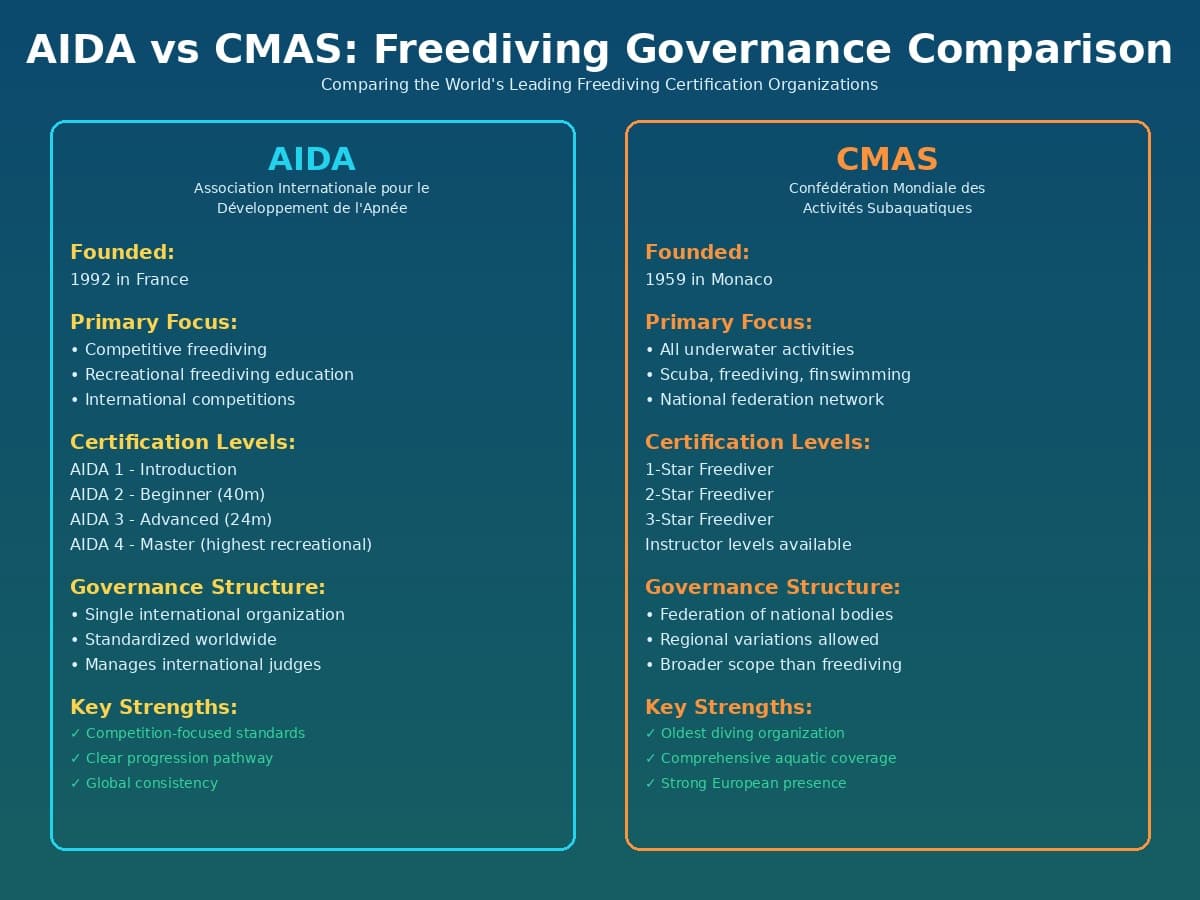
CMAS (Confédération Mondiale des Activités Subaquatiques, or World Underwater Federation) was founded in 1959 under legendary explorer Jacques Cousteau. It governs all underwater sports — finswimming, underwater rugby, spearfishing, and more. For decades, it was the only international body regulating freediving.
But in the late 1970s, as freedivers pushed past 100 metres and medical professionals questioned whether the human body could survive such depths, serious accidents began to occur. Following several fatalities involving high-profile divers, CMAS suspended all competitive freediving activities in the early 1980s.
The void left by CMAS's departure was eventually filled by AIDA (Association Internationale pour le Développement de l'Apnée), founded in Nice, France on November 2, 1992 by Roland Specker, Loïc Leferme, and Claude Chapuis. Created "by freedivers, for freedivers," AIDA established standardized competition rules and safety protocols for the emerging sport.
The 1988 film The Big Blue had sparked worldwide interest in freediving, leading to numerous record attempts. But without standardized rules or common safety guidelines, these attempts were organized haphazardly. AIDA was created to bring order — and safety — to the rapidly growing sport.
In 1995, responding to AIDA's success, CMAS re-entered freediving and resumed ratifying records — but under its own separate set of regulations. From this point forward, the sport has been governed by two completely separate organizations.
AIDA vs CMAS: Key Differences
While both organizations govern the same sport, significant differences exist in their rules, structures, and approaches.
Structure and Recognition
CMAS is recognized by the International Olympic Committee (IOC) as the governing body for underwater sports. It's a member of WADA (World Anti-Doping Agency) and has 130 national federations across five continents.
AIDA is a democratic, volunteer-based organization focused exclusively on freediving. It's the larger organizer of international freediving competitions but is not IOC-recognized and only recently began formal anti-doping programs.
Record Recognition
CMAS does not recognize world records set by AIDA, and AIDA does the same to CMAS. This means a freediver can hold a "world record" under one organization while their achievement is unrecognized by the other.
CMAS further distinguishes records by environment — separating freshwater from saltwater performances, and 25m pool from 50m pool results. AIDA does not make these distinctions.
Rule Differences
Key competition rule differences include:
Surface protocol: In CMAS, athletes must complete the post-dive surface protocol in 20 seconds with no coaching allowed. AIDA allows slightly more flexibility.
Dolphin kicks: In AIDA Dynamic with Bifins (DYNB), dolphin kicks are not permitted. CMAS allows dolphin kicks within the first 3 metres at the start and after each turn.
Age categories: CMAS has multiple age categories from 18 to 70+. AIDA uses open categories.
Team competitions: AIDA holds team competitions; CMAS focuses primarily on individual events.
Anti-Doping
CMAS, as a WADA signatory, has an established anti-doping program with random testing during competition and mandatory testing for world record attempts. Following the 2023 Vertical Blue controversy, CMAS also banned benzodiazepines and sildenafil — substances not on WADA's prohibited list but deemed potentially performance-enhancing or dangerous in freediving contexts.
AIDA was not a WADA Code signatory until recently, though it has since hired Clean Game (an independent anti-doping organization) and created an Anti-Doping Manager position. In late 2024, AIDA's research project "Misuse of Benzodiazepines in Freediving Competitions" was selected for WADA funding.
The 2023 Vertical Blue Doping Controversy
The fragile relationship between AIDA and CMAS shattered in 2023 following a scandal at Vertical Blue, the prestigious annual competition held at Dean's Blue Hole in the Bahamas and organized by world record holder William Trubridge.
What Happened
On July 4, 2023, competition organizer William Trubridge conducted a luggage search of Croatian freedivers Petar Klovar and Vitomir Maričić upon their arrival in the Bahamas. The search reportedly revealed four substances:
Sildenafil (Viagra)
Diazepam (Valium)
Alprazolam (Xanax)
Furosemide (a diuretic)
Of these, only furosemide appeared on WADA's 2023 Prohibited List. The others were on Vertical Blue's own list of prohibited substances — a list created by the competition organizer, not an international federation.
Both athletes were immediately banned from Vertical Blue 2023 and all future editions. Official urine doping tests taken after the luggage search were negative — no banned performance-enhancing substances were detected.
Why These Substances Matter in Freediving
While benzodiazepines (Valium, Xanax) and sildenafil aren't on WADA's prohibited list, they have potential implications for freediving:
Benzodiazepines are sedatives that reduce anxiety, slow metabolism, and decrease oxygen consumption. They could theoretically help an athlete remain calm under extreme pressure — but they also risk dangerous sedation, reduced consciousness, and enhanced narcosis at depth.
Sildenafil is a vasodilator that could theoretically benefit blood oxygen saturation. Some research suggests it may help prevent high-altitude pulmonary edema, and freediving involves similar physiological stresses.
CMAS's medical director stated that benzodiazepines are "totally unfair as assimilated to a doping practice to enhance performance" while also being dangerous to the athlete's health.
The Split
In January 2024, CMAS found both athletes guilty of breaching its Code of Ethics and imposed €5,000 fines and six-month suspensions. The ruling centered on "possession of substances capable of influencing performance or endangering athlete safety" — not positive doping tests.
But before CMAS announced its ruling, AIDA allowed both athletes to compete at its Depth World Championships in Limassol, Cyprus, in September 2023. There, Petar Klovar set an AIDA world record in Free Immersion (FIM), with Maričić finishing second in the same category.
For CMAS, this was unacceptable. In October 2023, CMAS released a statement referring to "recent developments at the AIDA international freediving event in Bahamas and the following event in Cyprus, which appear to be far from the CMAS standards," and announced it would "discontinue further cooperation with AIDA."
CMAS subsequently announced plans to launch its own "World Series of Freediving" starting in 2024.
Conflicts of Interest
The controversy raised uncomfortable questions about governance. William Trubridge — the competition organizer who ordered the luggage search — is also a competing athlete at Vertical Blue and holds multiple world records. WADA's response indicated that while an athlete-organizer shouldn't be directly involved in implementing testing programs, this conflict of interest is not explicitly prohibited in current regulations.
Adding to the complexity: Trubridge proposed to AIDA a vote to ban the Croatian athletes from AIDA's World Championship and to prohibit benzodiazepines and sildenafil. AIDA USA Vice President Francesca Koe also serves as Vertical Blue's Chief of Media.
Political Interference: The Taiwan Flag Controversy
The governance problems extend beyond doping. In September 2021, at the AIDA Individual Depth Freediving World Championship in Cyprus, AIDA removed Taiwan's flag from the live broadcast after receiving a request from Chinese authorities.
According to AIDA, streaming had been blocked in China, halting the broadcast for "400,000+ viewers." AIDA stated the request "took us by surprise" and the team "was not prepared to deal with it on such short notice."
Taiwanese athletes were given two options: leave the space for their flag blank, or compete under the banner of Chinese Taipei. They chose the blank space, as the Olympic flag "signifies the long oppression [of Taiwan] by China" on the international stage.
International Solidarity
The response from the freediving community was swift. Japan was the first of at least ten countries to request their own flags be removed in solidarity with Taiwan. Countries backing Taiwan included Australia, Croatia, France, Germany, Japan, Slovenia, South Korea, Russia, the USA, and the Netherlands.
Taiwanese athlete Mia Hou completed her dive and "proudly held Taiwan's national flag up in the water in full view of the camera." More than two-thirds of competing athletes' national flags were removed by request.
AIDA apologized, and Taiwan's President Tsai Ing-wen publicly thanked the supporting athletes. But the controversy continued — at the 2022 AIDA World Championship in Bulgaria, Taiwanese athletes received a letter asking them to confirm participation "under Chinese Taipei." Medal-winning Taiwanese divers were required to perform their victorious dives under the AIDA International flag.
The Tory George Case
The 2023 controversy also involved American freediver Tory George, who was subjected to doping control at Vertical Blue and claims he received a false positive.
According to George, he was unofficially informed about his July 4 doping control result on August 6, 2023 — via the AIDA USA President, who had reportedly received a call from William Trubridge. George only received his official results via email from the International Testing Agency on August 10 — four days after the unofficial disclosure.
George stated that "the positive result of my drug test was not communicated in the correct way," noting this violates WADA Code Article 14.1.2 regarding confidentiality of results.
As of mid-2024, George was still awaiting testing of his B sample — the next step in the process after an Adverse Analytical Finding. If the B sample tests negative, he could be cleared. He did not compete at the 2023 AIDA World Championships and has filed a formal complaint against AIDA USA.
The Olympic Question
Adding to the governance complexity is the question of Olympic recognition. CMAS is recognized by the IOC as the governing body for underwater sports and believes freediving is "the underwater sport most likely to win acceptance as an Olympic sport."
Freediving actually was in the Olympics once — at the 1900 Summer Games, athletes competed in underwater swimming. French athlete Charles Devendeville won gold with a 60m dive in 68.4 seconds. But the sport was discontinued due to safety concerns.
For modern Olympic inclusion, freediving would need to meet several requirements:
Practiced by men in at least 75 countries on four continents
Practiced by women in at least 40 countries on three continents
Increase the "value and appeal" of the Olympic Games
Unified international governance
The last point is the challenge. With AIDA and CMAS operating as rivals — especially now that cooperation has broken down — the sport presents a fractured face to the IOC.
CMAS, as the IOC-recognized body, has positioned itself as the path to Olympic inclusion. In 2024, it launched the "World Series of Freediving" and held its 2025 World Championship at the Olympic Aquatic Centre in Athens.
But many of the world's top athletes compete primarily in AIDA events. The sport remains divided.
The Other Bodies: IAFD and FREE
AIDA and CMAS aren't the only organizations that have governed freediving. Two others rose and fell:
IAFD (International Association of Freedivers) was established in 1996 by Francisco "Pipin" Ferreras, the controversial No Limits freediver, in direct opposition to AIDA. IAFD monitored Ferreras's later records but had limited success and shut down in 2004.
The organization is forever linked to tragedy: IAFD organized the 2002 No Limits attempt in which French freediver Audrey Mestre died at 171 metres. The onsite safety measures were heavily criticized, contributing to the sport's ongoing concerns about extreme depth attempts.
FREE (Freediving Regulations and Education Entity) was formed in Italy in 1999 in protest of controversial AIDA decisions. Like IAFD, it didn't survive.
Today, only AIDA and CMAS remain as competitive freediving's governing bodies.
What This Means for Athletes
The fragmented governance creates practical problems for freedivers:
Confusing records: An athlete might hold a "world record" under one organization that's unrecognized by the other. Media often reports records without clarifying which body sanctioned them.
Competition choices: Athletes may need to choose between AIDA and CMAS events, potentially limiting their competitive opportunities.
Anti-doping uncertainty: Different substances are banned by different bodies. Athletes competing in both organizations must navigate varying prohibited lists.
No government support: Because freediving isn't an Olympic sport, athletes in most countries don't receive Ministry of Sports funding — regardless of their achievements.
Political pressures: As the Taiwan flag controversy showed, athletes can be caught in geopolitical disputes with little recourse.
For recreational freedivers and those taking certification courses, the governance split is less impactful — AIDA and CMAS certifications are both respected, and other agencies (Molchanovs, SSI, PADI) offer their own programs. But for competitive athletes aiming at world records or championship titles, the fractured landscape is a significant frustration.
Can the Sport Reunite?
The October 2023 break was significant. CMAS explicitly stated it would "discontinue further cooperation with AIDA," and has since positioned its World Series of Freediving as an alternative competitive pathway.
Some developments suggest progress:
AIDA has strengthened its anti-doping program, hiring external expertise and securing WADA funding for research
Both organizations continue to host successful world championships with strong athlete participation
As of 2025, athletes must complete WADA's Anti-Doping eLearning (ADEL) Certificate to compete in CMAS events
But fundamental differences remain. CMAS views itself as the legitimate, IOC-recognized governing body with proper anti-doping infrastructure. AIDA sees itself as the authentic voice of the freediving community, built by athletes rather than bureaucrats.
Until these organizations find common ground — or one clearly supersedes the other — freediving will continue with two separate sets of rules, two sets of records, and two competing visions for the sport's future.
Summary
Freediving's governance problems run deep:
Two rival organizations (AIDA and CMAS) that don't recognize each other's records
A 2023 doping scandal that severed cooperation between them
Ongoing questions about conflicts of interest between athlete-organizers and competition integrity
Political interference, as seen in the Taiwan flag controversy
An uncertain path to Olympic recognition while the sport remains divided
For aspiring freedivers, none of this should discourage you from learning the sport. The water doesn't care about governance disputes. But understanding the landscape helps explain why you might see different "world records" reported for the same discipline, why some athletes boycott certain competitions, and why the sport's growth toward mainstream recognition has been slower than it might otherwise be.
The freediving community is passionate, welcoming, and growing. The governance will eventually catch up.
For more on freediving, see our complete guide to the sport, learn about the eight competitive disciplines, or explore Melbourne training options.
Courses & Certification — Complete Series
- 1Freediving Certifications: AIDA, PADI, SSI, Molchanovs & FII Comparison Guide
- 2AIDA vs CMAS: The Fractured World of Freediving Governance
- 3How to Evaluate a Freediving Instructor Before You Book
- 4My Experience with Drifters Freediving Melbourne: Training Standards and Safety Concerns
- 5How Freediving's Governing Bodies Are Failing the Sport: What Every Freediving Student Should Know
- 6Manual of Freediving Review: The Definitive Guide to Underwater Breath-Hold Diving