Equalization Techniques: A Complete Guide
Understanding the techniques—and why proper instruction is essential for your safety
Introduction
Equalization is one of the most challenging skills in freediving and one of the most common reasons divers hit depth plateaus. It's also a technique where improper practice can lead to injury.
This guide explains the major equalization techniques, helps you understand what's happening in your body, and outlines why hands-on instruction is particularly important for this skill.
Why Equalization Matters
As you descend underwater, pressure increases. At 10 meters depth, pressure has doubled compared to the surface. This pressure affects the air spaces in your body—primarily your ears and sinuses.
Without equalization:
Pressure pushes your eardrums inward
You experience pain (at first) then potential injury
Barotrauma (pressure-related injury) can result in bleeding, infection, or permanent hearing damage
The golden rule: Equalize early and often, BEFORE you feel pain. If you feel pain, you've waited too long.
Understanding Your Air Spaces
Middle Ear: Your middle ear is an air-filled space behind your eardrum, connected to your throat via the Eustachian tubes. When pressure increases during descent, you must actively open these tubes to allow air to flow in and equalize the pressure.
Sinuses: Your sinuses are air cavities in your skull. When healthy, they typically equalize automatically along with your ears. Congestion can prevent this, which is why you should never freedive with a cold.
Mask: Your mask creates an additional air space that needs equalizing. This is simply done by exhaling a small amount through your nose into the mask.
Equalization Techniques
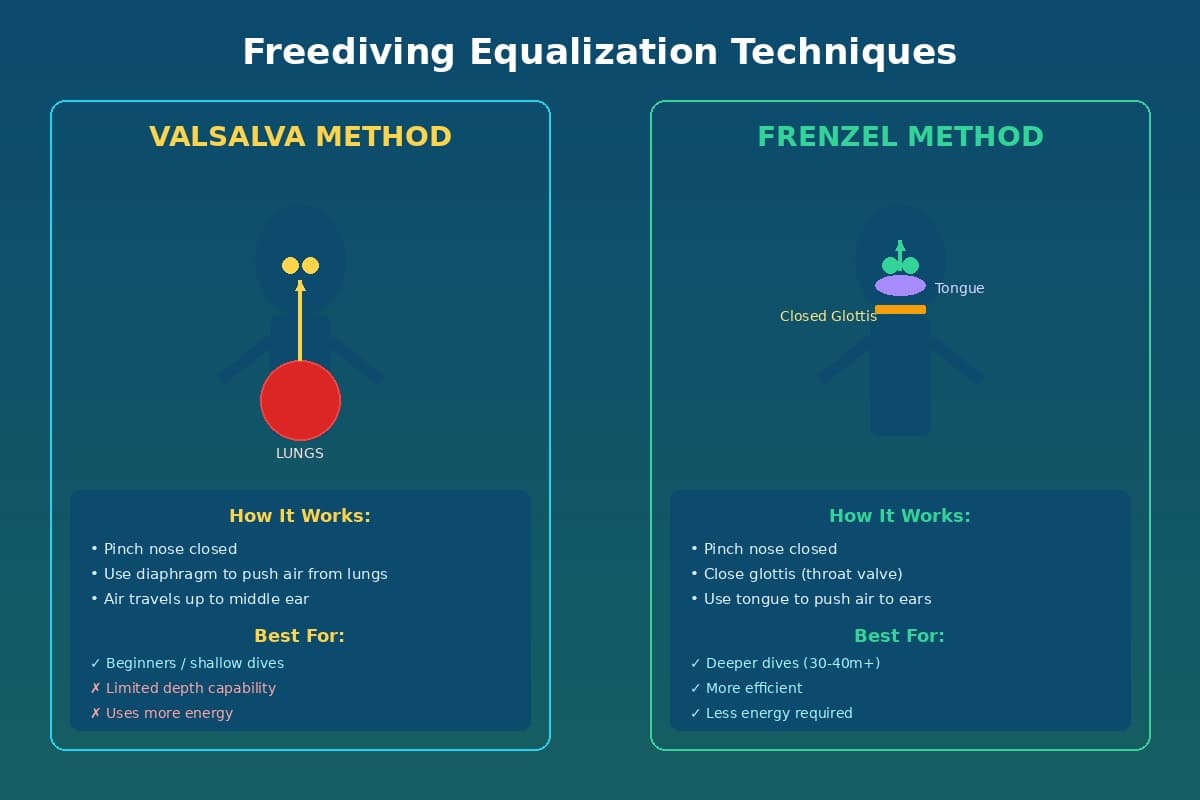
Valsalva Maneuver
What it is: Pinch your nose and gently try to exhale against closed nostrils, creating pressure that opens the Eustachian tubes.
Pros:
Simple to learn
Intuitive for beginners
Effective in the first few meters
Cons:
Requires lung volume to create pressure
Becomes ineffective as lungs compress with depth (typically below 10-15m)
Can create unwanted tension
Risk of injury if forced too hard
When it's taught: Most beginner courses teach Valsalva because it's accessible and works for initial depths. However, serious freedivers need to progress beyond it.
Frenzel Technique
What it is: Close your glottis (the valve at the back of your throat), trap air in your mouth and throat, and use your tongue as a piston to push air into your ears.
Pros:
Much more efficient than Valsalva
Works at greater depths (up to 30-40m+)
Uses less energy
Creates less tension in the body
Allows for more frequent, gentle equalizations
Cons:
Significantly harder to learn
Requires developing awareness of muscles you may never have consciously controlled
Difficult to self-diagnose problems
Requires substantial practice
Why instruction matters: Frenzel is difficult to learn from text or video alone. An experienced instructor can watch your throat and identify what's not working, provide immediate feedback, offer progressive exercises tailored to your challenges, and help you develop muscle awareness.
Mouthfill Technique
What it is: At a certain depth (typically around 30-40m), lung volume becomes too small for even Frenzel to work. Mouthfill involves filling your mouth with air at a specific depth, then using only that air to equalize for the rest of the descent.
This is an advanced technique that should only be learned after solid Frenzel competency, under expert instruction.
Hands-Free Equalization (BTV)
Some people can equalize without pinching their nose, using Béance Tubaire Volontaire (BTV). This involves voluntarily opening the Eustachian tubes through muscle control. This is relatively rare—some people have natural ability; most cannot learn it.
Critical Safety Points
Never Force Equalization
If equalization doesn't work easily, abort the dive and return to the surface. Forcing equalization can cause:
Eardrum rupture
Middle ear barotrauma
Permanent hearing damage
Vertigo (disorientation underwater—extremely dangerous)
What quality instruction emphasizes: A good instructor will never pressure you to descend if you cannot equalize comfortably. They will teach you that aborting a dive is always the right call when equalization fails.
Equalize Before You Feel Pressure
By the time you feel pressure or discomfort, you're already behind. The first 10 meters are the most critical because this is where pressure change is greatest (from 1 to 2 atmospheres—a 100% increase).
Good practice: Begin equalizing at the surface and continue every meter or every few kicks during descent.
Never Dive Congested
If your sinuses are blocked due to cold, allergies, or infection:
Equalization becomes difficult or impossible
Forcing it can cause sinus barotrauma
Mucus can be forced into your Eustachian tubes
Risk of reverse block on ascent (trapped air that can't escape)
Wait until you're healthy to dive.
Common Equalization Problems
"I can't equalize past X depth"
This is extremely common and usually has solvable causes: technique issues (often Valsalva limitations), tension (which closes the Eustachian tubes), not equalizing early or often enough, head position (looking up can make equalization harder), or individual anatomy variations.
What instruction provides: An experienced instructor can diagnose your specific issue.
Equalization is harder in head-down position
This is normal. When you're upside down during a descent, the mechanics change. Techniques that work well at the surface may need adjustment. This is why pool and open water practice with feedback is essential.
One ear is harder than the other
Asymmetric equalization is common, often related to previous injuries/infections, anatomical differences, or technique (unconsciously favoring one side). A qualified instructor can help identify the cause and suggest adaptations.
Red Flags in Equalization Instruction
Be cautious of instructors who:
Push you past failed equalization — If you can't equalize, you don't descend. Period. Any instructor who pressures you otherwise is dangerous.
Dismiss discomfort — Pain is a signal something is wrong. It should never be ignored.
Skip dry practice — Good equalization instruction includes significant time on land developing awareness and technique before you're underwater.
Don't teach abort protocols — You should know exactly when and how to safely abort a dive.
Rush through the topic — Equalization problems are one of the biggest limiting factors in freediving. It deserves substantial attention.
What You Can Practice Safely
Dry Practice (Safe to Practice Alone):
Practice the movements of Frenzel (tongue position, glottis closure)
Use a mirror to watch your throat
Practice in different positions (sitting, lying down, inverted)
Build muscle memory before adding the complexity of water
Note: Dry practice builds awareness and control but doesn't fully replicate actual diving conditions. It's preparation, not replacement, for supervised water practice.
What Requires Supervision:
Any equalization practice with actual breath-holding
Depth training
Testing equalization limits
Practicing in head-down positions underwater
The Value of Proper Instruction for Equalization
Equalization is perhaps the skill that most benefits from hands-on instruction because:
You can't see what you're doing wrong. The muscles involved are internal. Without feedback, you may be reinforcing bad habits.
Everyone's anatomy is different. Techniques may need individual adaptation.
Problems are often subtle. Small issues in timing, tension, or technique have big effects.
The consequences of poor practice are real. Barotrauma is painful and can cause lasting damage.
When evaluating a course or instructor, ask:
How much time is spent on equalization?
Do you teach Frenzel, or only Valsalva?
How do you help students who struggle with equalization?
What's your approach when someone can't equalize?
A good answer acknowledges that equalization is challenging, describes a patient approach, and emphasizes never pushing past discomfort.
Conclusion
Equalization is a fundamental freediving skill that determines how deep you can safely dive. While understanding the techniques intellectually is valuable, developing actual competency requires supervised practice with feedback, patient instruction tailored to your individual challenges, and a safety-first approach that never pushes past discomfort.
Before enrolling in any freediving course, verify your instructor's credentials and ask about their approach to equalization instruction. This is an area where quality instruction makes a significant difference to both your progress and your safety.
📚 Educational Content Only: This guide is for educational purposes and does not replace professional freediving instruction. Before attempting any breath-hold training, equalization techniques, or depth diving, you must complete a certified freediving course with a qualified instructor (AIDA, PADI, SSI, Molchanovs, or FII). Never practice breath-holding in water without a trained safety buddy present.
Equalization Mastery — Complete Series
- 1Equalization Techniques: A Complete Guide
- 2Boyle's Law and Equalization: Why the First 10 Meters Matter Most
- 3Frenzel Equalization: Complete Troubleshooting Guide
- 4Mouthfill Equalization Tutorial: The Deep Diving Gateway