Beyond the Breath: How Freediving is Used Around the World
From ancient pearl divers to modern world records, freediving serves purposes most people never imagine
When most people think of freediving, they picture competitive athletes descending to impossible depths on a single breath. But competitive freediving is just one small slice of this ancient practice. Freediving has been woven into human culture for thousands of years, and today it serves an astonishing variety of purposes—from putting food on the table to advancing marine science, from Hollywood film production to Olympic-adjacent sports you've probably never heard of.
This guide explores the full spectrum of how freediving is used around the world, from traditional cultures where it remains a way of life to cutting-edge applications in conservation and research.
Traditional Freediving Cultures
Long before freediving became a sport, it was survival. Several cultures around the world developed sophisticated breath-hold diving traditions that continue today—and some have even evolved genetic adaptations that give them superhuman underwater abilities.
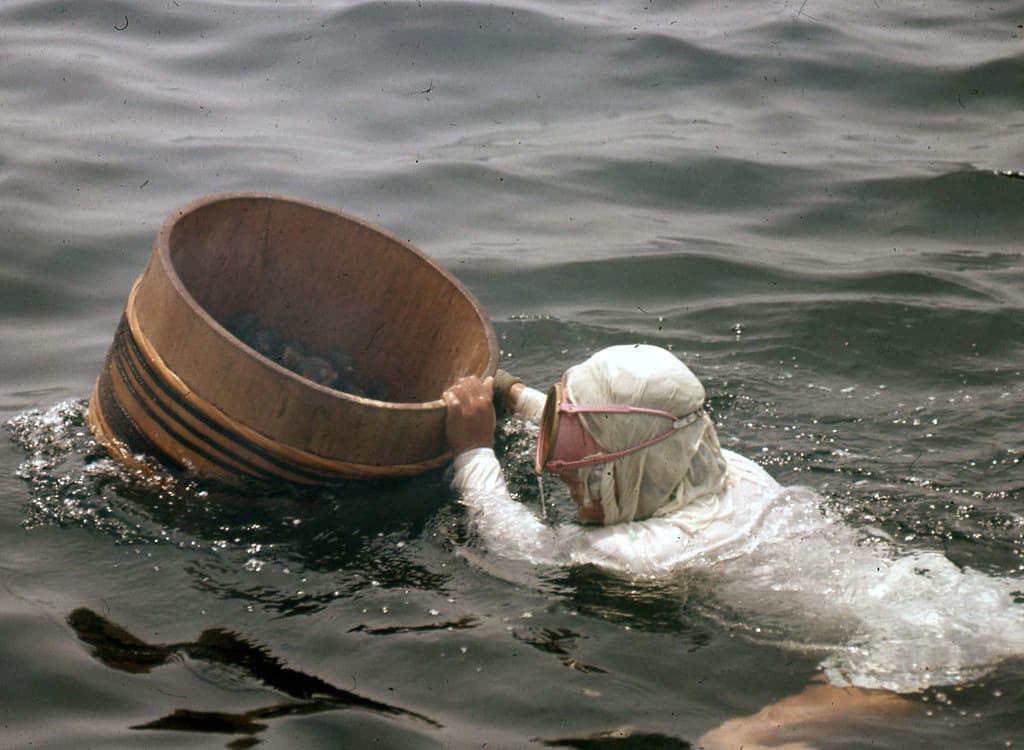
The Ama of Japan: 2,000 Years of Sea Women
The Ama (海女, meaning "sea women") are Japanese freedivers whose tradition dates back at least 2,000 years, with written records from 927 AD. These women dive for abalone, sea urchins, seaweed, and pearls—a practice so valued that Ama were historically honored with the task of collecting abalone for shrines and imperial emperors.
What makes the Ama remarkable:
They dive without scuba gear, relying entirely on breath-hold techniques
Many continue diving into their 70s and 80s
They use a distinctive recovery breathing technique called isobue (sea whistle)—a long, slow exhalation with the upper lip drawn over the lower, creating a whistling sound
Most Ama equalize hands-free using Voluntary Tubal Opening (VTO), a technique modern freedivers consider advanced
Experienced funado (boat divers) descend to 25 meters using a 20kg weight, then are pulled back up by rope
The Ama tradition influenced the birth of modern freediving. Jacques Mayol, who revolutionized competitive freediving and inspired the film The Big Blue, spent his childhood summers in Japan watching Ama divers. He credited them with sparking his lifelong fascination with breath-hold diving.
Today, fewer than 2,000 Ama remain active, most in their 60s or older. The tradition has become a cultural tourism attraction in Mie Prefecture, where visitors can dive with Ama and experience their lifestyle firsthand.
The Haenyeo of Korea: Jeju's Diving Women
On South Korea's Jeju Island, the Haenyeo (해녀, also meaning "sea women") practice a remarkably similar tradition. First recorded in 1629, these women harvest shellfish, sea urchins, abalone, and seaweed, diving up to 7 hours a day for 90 days of the year.
Key characteristics:
At their peak in the 1960s, approximately 30,000 Haenyeo were active; today around 5,000 remain, most over 60
Like the Ama, they use a distinctive whistling breath called sumbisori for recovery
Their knowledge of tidal patterns, seasonal cycles, and sustainable harvesting is encyclopedic
Training is passed from mother to daughter, with girls learning from experienced elders
The Haenyeo have become a symbol of Korean women's resilience and independence
In 2016, UNESCO recognized the Haenyeo culture as an Intangible Cultural Heritage of Humanity, acknowledging their sustainable practices and the community knowledge they preserve.
The Bajau: Genetically Adapted "Sea Nomads"
Perhaps the most extraordinary freediving culture belongs to the Bajau people of Southeast Asia, who have lived almost exclusively on the water for over 1,000 years. Known as "Sea Nomads," the Bajau traditionally lived on houseboats in the waters of Indonesia, Malaysia, and the Philippines, diving for fish, shellfish, and other marine resources.
The Bajau are remarkable for several reasons:
They routinely dive to depths of 70+ meters (230 feet) without modern equipment
Some can hold their breath for up to 13 minutes
They traditionally use only wooden goggles and handheld weights
But the most astonishing discovery came in 2018, when researchers published findings in the journal Cell showing that the Bajau have genetically adapted to their diving lifestyle:
50% larger spleens: The spleen contracts during diving, releasing oxygen-rich red blood cells. Larger spleens provide a bigger oxygen reservoir.
Genetic mutation in PDE10A gene: This gene controls thyroid hormone levels, which influence spleen size. Natural selection over ~1,000 years has favored this variant.
Enhanced diving reflex: Researchers found evidence of selection on BDKRB2, a gene affecting the human diving response.
This was the first documented case of genetic adaptation to diving in humans—essentially, the Bajau have evolved to be better divers. Even non-diving Bajau individuals have enlarged spleens, confirming it's genetic rather than simply a training effect.
Greek Sponge Divers and Skandalopetra
In the Mediterranean, Greek sponge divers developed their own freediving tradition using skandalopetra—heavy stones (15-20kg) attached to a rope. The diver would grip the stone and descend rapidly to the seafloor, collect sponges, then signal to be pulled back up.
One remarkable account from 1913 describes Stathis Chantzis, a Greek diver who descended to 83 meters to help recover a lost ship anchor—an astounding feat for the era, performed with nothing but a stone weight and a rope.
Competitive Freediving: Pushing Human Limits
Modern competitive freediving began in the 1940s and 1950s when pioneers like Raimondo Bucher, Enzo Maiorca, and Jacques Mayol started systematically testing the limits of human breath-hold diving. What they discovered overturned scientific assumptions: doctors had believed the human chest would collapse below 50 meters. Freedivers proved them wrong again and again.
Today, competitive freediving is governed by two main organizations: AIDA International (International Association for the Development of Apnea) and CMAS (Confédération Mondiale des Activités Subaquatiques). Both sanction world records and organize championships.
Pool Disciplines
Static Apnea (STA): The diver floats face-down in a pool, holding their breath as long as possible. No swimming, no movement—pure breath-hold. Current men's record: 11 minutes 35 seconds (Stéphane Mifsud, France, 2009)
Dynamic Apnea with Fins (DYN): Swimming horizontally underwater for maximum distance, using a monofin or bi-fins. Current men's record: 300+ meters
Dynamic No Fins (DNF): Same as above, but using only breaststroke-style movement—no fins allowed. Current men's record: 298 meters (Guillaume Bourdila, France, 2025)
Depth Disciplines
Constant Weight with Fins (CWT): The diver descends and ascends using fins, without changing their weight or pulling on the line. This is considered the purest expression of deep freediving. Current men's record: 136 meters (Alexey Molchanov, 2023). Current women's record: 123 meters (Alessia Zecchini, Italy)
Constant Weight No Fins (CNF): The diver descends and ascends using only arm strokes and leg kicks—no fins. Considered the most challenging depth discipline. Current men's record: 103 meters (Petar Klovar, Croatia)
Free Immersion (FIM): The diver pulls themselves down and up along a vertical rope. No fins used. Current men's record: 135 meters (Petar Klovar, 2023)
No Limits (NLT): The diver descends on a weighted sled and ascends using a lift bag or mechanical device. This is the deepest humans go on a single breath—and the most dangerous. Current men's record: 214 meters (Herbert Nitsch, Austria, 2007)
Freediving was introduced to the World Games in 2025 in Chengdu, China, marking a significant step toward broader international recognition.
Spearfishing: The Original Applied Freediving
Spearfishing is likely the oldest application of freediving—humans have been spearing fish underwater for at least 16,000 years, based on cave paintings found in Cosquer Cave in southern France. Today, it exists in forms ranging from subsistence fishing to high-level international competition.
Why Freedivers Make Better Spearfishers
Modern spearfishing can be done with scuba gear, but many practitioners prefer freediving because:
Stealth: No bubbles from scuba gear to spook fish
Mobility: No tank or heavy equipment to maneuver
Connection: Many describe a more "honest" hunt when you're limited by your own breath
Sustainability: Natural limitations prevent over-harvesting
Access: Many areas restrict scuba spearfishing but allow freediving
Competitive Spearfishing
CMAS governs international spearfishing competition. In a fascinating footnote, spearfishing nearly became an Olympic sport. Throughout the 1950s and 1960s, organizations lobbied for inclusion. The sport was beaten out by synchronized swimming for the 1968 Olympics—a decision that still frustrates spearfishing advocates today.
Underwater Photography and Filmmaking
Freediving has become an essential tool for underwater photographers and filmmakers, offering advantages that scuba simply cannot match.
Why Freediving for Photography?
No bubbles: Scuba exhaust creates clouds of bubbles that spook marine life and ruin shots. Freedivers can approach skittish animals that would flee from a scuba diver.
Mobility and speed: Without tanks and heavy gear, freedivers can move faster and more naturally through the water.
Animal interaction: Marine animals, particularly sharks and large mammals, often approach freedivers more closely than scuba divers.
Notable Freediving Photographers
Fred Buyle: A former world-record freediver who transitioned to underwater photography and scientific work. His images of freedivers swimming with tiger sharks went viral and changed public perception of shark encounters.
William Winram: A record-holding freediver who founded the Watermen Project, an organization where breath-hold diving serves ocean conservation.
Marine Science and Conservation
Freediving has become an increasingly valuable tool for marine researchers, offering unique advantages for studying species that are disturbed by scuba equipment.
Research Applications
Shark tagging: Freedivers like William Winram and Fred Buyle have attached acoustic tracking tags to hammerhead sharks, great whites, and other species.
Coral reef surveys: Freediving allows researchers to quickly cover large areas of reef.
Marine mammal studies: Whales, dolphins, and seals often respond negatively to scuba bubbles and noise. Freedivers can observe natural behaviors without disruption.
Underwater Sports
Beyond competitive freediving itself, breath-hold diving forms the foundation of several team sports with dedicated international communities and organized world championships.
Underwater Hockey (Octopush)
Invented in 1954 by Alan Blake in England, two teams of six push a heavy puck along the bottom of a swimming pool using short sticks. Players must constantly surface to breathe, creating dynamic substitution patterns. The first World Championship was held in Canada in 1980.
Underwater Rugby
Developed in Germany in the 1960s, two teams of six compete for a slightly negatively buoyant ball. Teams score by placing the ball into the opponent's goal—a heavy metal bucket at the bottom of the pool. CMAS recognized underwater rugby in 1978.
Aquathlon (Underwater Wrestling)
Developed in the former USSR during the 1980s, aquathlon involves two competitors wearing masks and fins wrestling underwater to remove a ribbon from each other's ankle band.
Commercial and Industrial Applications
Beyond sport and tradition, freediving skills have practical commercial applications including pearl diving, film and stunt work, professional safety diving, and aquarium/marine park work.
Therapeutic and Wellness Applications
Many freedivers describe the practice as deeply meditative. The requirement for complete relaxation, focus on breath, and presence in the moment shares much with meditation practices. The mammalian dive reflex—the physiological response triggered by breath-holding and facial immersion—naturally slows heart rate and induces calm.
Mermaiding: The Newest Application
One of the fastest-growing applications of freediving skills is "mermaiding"—swimming while wearing a costume mermaid tail. What started as a niche hobby has grown into a subculture with international competitions, professional performers, specialized equipment manufacturers, and dedicated training programs.
The Future of Freediving
Freediving continues to evolve and find new applications:
Medical research: The Bajau genetic studies opened new avenues for understanding hypoxia tolerance.
Virtual reality: Freediving photographers are capturing 360° footage for VR experiences.
Climate and ocean monitoring: Recreational freedivers increasingly contribute data on water temperature and ecosystem health.
World Games recognition: Freediving's inclusion in the 2025 Chengdu World Games marked a milestone.
Conclusion
Freediving is far more than a sport—it's a thread that connects ancient human cultures to cutting-edge science, subsistence fishing to Olympic-caliber athletics, Hollywood productions to marine conservation. Whether practiced by Japanese Ama who've been diving for generations or Australian researchers tagging sharks, freediving represents one of humanity's oldest and most intimate connections with the underwater world.
For those considering learning to freedive, the applications are as varied as your imagination. The ocean is waiting. Take a breath.
Ready to explore the underwater world? Check out our guides to freediving certifications, safety fundamentals, and equalization techniques.
Getting Started — Complete Series
- 1What is Freediving? The Complete Beginner's Guide
- 2Why Do People Freedive? The Psychology and Joy Behind Breath-Hold Diving
- 3Freediving Disciplines Explained: Pool, Depth & Everything In Between
- 4Freediving vs Scuba Diving: Key Differences Explained
- 5Beyond the Breath: How Freediving is Used Around the World